


The Institute for Sustainability and Environmental Professionals (ISEP), supported by Rebuilding Nature Alliance member, Jacobs, released a policy paper in January that demonstrates nature already meets the UK Government's definition of critical national infrastructure (CNI). The paper collates existing evidence to illustrate this, considering both the significant risks of biodiversity loss for economic growth, wellbeing, and national resilience, and the opportunities presented by the transition to a nature positive economy.
When we think of critical national infrastructure, we tend to picture transport systems, power stations or built assets that support digital systems: the visible networks that keep our economy running. But there are other networks of assets, barely accounted for in our economic models, that underpins every one of them: nature and natural capital, which provide flows of essential ecosystem services.
The Office for National Statistics values U.K. ecosystem services at around £1.8 trillion which is equivalent to roughly 72% of the country’s GDP. The Green Finance Institute estimates that environmental degradation could reduce gross domestic product by 6–12% by the 2030s – a greater loss than the 2008 financial crisis. The paper also refers to evidence that for every £1 spent, nature-based solutions can deliver up to £3 in economic and social returns, from job creation to improved public health and biodiversity.
The ISEP paper sets out the conceptual framework for natural capital as critical infrastructure. It argues that networks of natural capital assets could be defined as a ‘trunk road network’ for nature. It provides six policy recommendations for embedding natural capital more effectively into economic decision making. These are summarised as:
1. Relevant government bodies should formally recognise natural capital as critical infrastructure
2. Create a Strategic Nature Network (SNN) and designate it as a Government Major Project and a Nationally Significant Infrastructure Project
3. Recognise the SNN in National Policy Statements and Spatial Development Strategies
4. Explicitly recognise the economic importance of natural capital and delivering the Environmental Improvement Plan
5. Establish a dedicated Natural Infrastructure Investment Fund
6. Develop guidance and training on natural capital and asset management approaches
Recommendation 2 is central to ISEP’s positive vision and aligns with Rebuilding Nature’s work to create the UK’s first SNN. The recommendation in full is to:
Establish a Strategic Nature Network (SNN) in the Government Major Projects Portfolio (GMPP) and designate this as a Nationally Significant Infrastructure Project (NSIP). Create a Natural Infrastructure Delivery Body responsible for its delivery.
The ISEP paper explains that designating the SNN as an NSIP and listing it in the GMPP would create a national-scale project that can generate opportunities for growth by creating jobs and helping streamline delivery of nature restoration targeting the areas of greatest critical national need. The designation of the SNN as an NSIP could help to streamline its delivery and vital contribution to the Government’s 30x30 targets. Classification as a GMPP would also signal and unlock the multidisciplinary expertise and coordination across government departments, regulators, contractors, and communities.
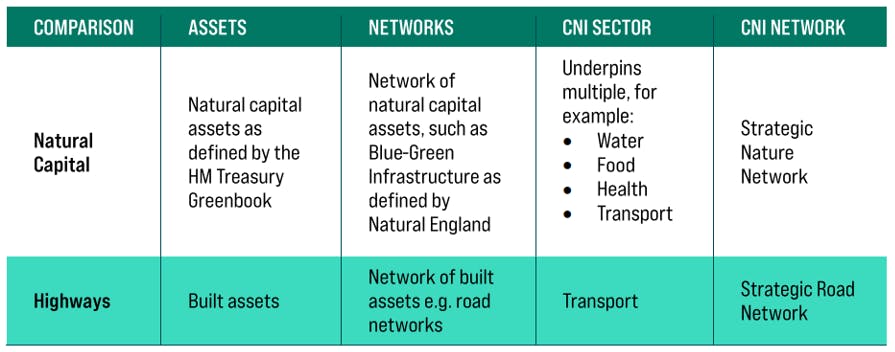
Implementing these recommendations would enable the SNN to move from being a national mapping layer to a physical infrastructure project, on a par with other national infrastructure projects in sectors like energy, transport, water and communications. The work of Rebuilding Nature to create Nature Investment Zones, the building blocks of the SNN are crucial for this.
ISEP’s other recommendations build the wider policy context for supporting Rebuilding Nature’s overall mission. These include recognition of existing CNI sectors by government bodies on the role of nature in providing ecosystem services and resilience, protection of the SNN in planning policy, and making existing asset management standards fit-for-purpose for natural assets. These would provide enabling actions that either directly support or indirectly enable the creation of the SNN by embedding the natural capital approach into government decision making.
Stephen Elderkin, Co-Founder of Rebuilding Nature and Director of Environmental Sustainability, National Highways, said: “The economy is embedded in and dependent on nature. Whether for materials, or ecosystem services such as flood management, carbon storage, air to breathe or food to eat, the health of the natural environment is the critical foundation on which a prosperous society is built. A strategic, resilient national nature network is critical national infrastructure.
“I welcome the ISEPs recommendations for a Strategic Nature Network and encourage all to join Rebuilding Nature in its construction.
“The SNN can help us make sense of all the initiatives and projects that are dispersed across the UK. It helps us communicate and inspire, with a vision for a better future. It shows that access to nature will be coming to your community with all the benefits for health and wellbeing that brings.
“It gives us confidence that we have a coherent plan and that delivering and maintaining it will ensure that the natural environment is sufficiently muscular and resilient, safeguarding the ecosystem services it provides. It can help us prioritise our spend and provides the strategic context within which to make the business case for individual interventions.”
Read ISEP’s paper here: https://www.isepglobal.org/resources/blogs/2026/january/isep-policy-paper-natural-capital-is-critical-infrastructure/
You can contribute to the conversation on LinkedIn by engaging with Rebuilding Nature’s post here: https://www.linkedin.com/posts/rebuilding-nature_natural-capital-as-critical-infrastructure-activity-7415300591779737600-F-ds?utm_source=share&utm_medium=member_desktop&rcm=ACoAABbv3J8Brvr7Nh90MAUR7HhkFYeo30jJOeY
With thanks to the authors Lesley Wilson and Jonathan Nichols

