


This years Highways UK conference was held on 15-16 October, filling a vast hall in the National Exhibition Centre in Birmingham. A festival of all things roads, there were 360 companies exhibiting, 5 stages and more than 10,000 visitors, including Ministers and senior government officials. The presentations, panel sessions and discussions in the hall measure the pulse of this infrastructure sector. In recent years, carbon and the challenge of getting to net zero highways has been prominent, this year it seemed that the relationship between nature and roads was the hot topic. Nature as critical infrastructure, nature for resilience and the contribution that the highways sector can make to nature recovery.

I was doing my bit to promote the nature topic throughout the event, including talking to the Roads Minister about nature recovery, as well as hosting a panel session on “Can we rebuild nature and roads at the same time?” I was joined for the panel session by other members of the Rebuilding Nature alliance: Harry Bowell from National Trust, Chris Sowerby from Jacobs, Julia Baker from Mott MacDonald and Sarah Brownlie, Rebuilding Nature’s development director. There was a lot of agreement, with Julia summarising this as:
· We know why nature recovery matters
· We know what we need to do;
· So, we now need to focus on the how and doing it.
Chris Sowerby concluded that success depends on recognising nature as ‘critical infrastructure’. I agree and am pleased to be hearing this phrase with increasing frequency. But I wonder if we all have the same definition of ‘critical infrastructure’ in mind when we say it?
Consider the example of the Strategic Road Network. Why is this considered critical infrastructure? ‘Infrastructure’, refers to a system, or collection of assets that in combination provide facilities or services. While a streetlight is an asset, it is not, in isolation, infrastructure. It is the combination of multiple assets, paved surfaces, structures, lighting, barriers, signposts… into a road network that qualifies to be called ‘infrastructure’. To be ‘critical’, infrastructure needs to be essential for the functioning of society. Highways meet this requirement. Nine times as much freight is moved by road as by rail, and nine out of ten miles travelled in the UK are by road. Without road infrastructure, we would have empty supermarket shelves, and the economy would falter.
The parallel for nature is that while trees, meadows or ponds are natural assets, on their own they are not infrastructure. It is the combination of these assets into a coherent, resilient ecological network that safeguards the ecosystem services that nature provides. The economy runs on the primary products of nature such as timber or cotton. The workforce is powered by food. Our climate and water cycles are regulated through natural processes and the stores of carbon held in soils and forests. And our wellbeing is enhanced by being connected to nature. Over half of the world’s GDP is highly or moderately dependent on nature . These ecosystem services could not be more essential. A thriving nature network provides the foundation for a prosperous, healthy, resilient society for all of us.
We know the prescription for nature recovery. The Lawton principles set it out as: “more, bigger, better and more joined up habitat ”. Achieving this provides a connected web of habitat which provides reservoirs of ecological complexity with the scale to re-start natural processes and support large and viable populations of species that are resilient to disease or adverse events. Target 3 in the Kunming-Montreal Global Biodiversity Framework requires countries not only to protect 30% of land and sea for nature, but to ensure that this is ‘well-connected’. Both the science and our international commitments point to maintaining a network of protected habitat. Unfortunately, the state of nature in the UK today compares poorly with this prescription. Our critical natural infrastructure is neglected, with habitat lost, degraded or fragmented putting at risk the ecosystem services that we all rely on. This is why Rebuilding Nature is mobilising a national effort to create a Strategic Nature Network .
[SE2]https://rebuildingnature.com/strategic-nature-network/
For the UK, the business case for creating a Strategic Nature Network is extremely strong. However, given the degraded state our natural environment is in, this will require a national scale cross-sectoral effort. The highways sector has an important contribution to make. The vegetated land in road verges across the UK occupies the same area as the county of Dorset, and these ribbons of habitat extend across the landscape from Kent to the Cairngorms and back down to Cornwall. While verges can improve habitat connectivity, the roads themselves fragment habitat. Interventions to increase the permeability of road networks to nature are needed if a truly joined up nature network is to be created.
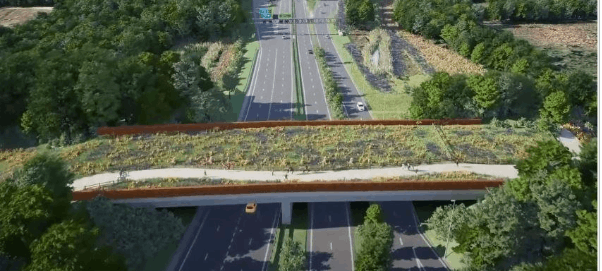
The National Highways stand at Highways UK celebrated a green bridge that is under construction near Wisley in Surrey. This bridge will open in the next few months. 30 metres wide, it will reconnect two heathlands, both Sites of Special Scientific Interest, that were severed by the construction of the A3 in the 1970s . A shared vision for a Strategic Nature Network would allow us to identify the highest priority locations to build nature crossings around our network; the locations that would have the greatest benefit to nature recovery. We need to deliver against all the Lawton principles, including a proportion of the investment directed to habitat defragmentation. At Highways UK, I had the opportunity to discuss the importance of nature crossings with the new Minister for roads Simon Lightwood in front of a model green bridge.
[SE1]https://youtu.be/jrq93QQHlpU?si=RY7mLdQAsGamMlzR

If nature was the hot topic for 2025 at Highways UK, then climate resilience was a close second. A wetter, hotter, windier future presents multiple challenges for the safe operation of roads. Most worrying of these is wetter: where climate change is expected to cause both more, and more intense, rainfall. This cannot be managed just through more construction. National Highways updated their design standards for drainage systems back in 2006, to allow for climate scenarios, increasing capacity by at least 20%. For new build, this is helpful, but only 7% of the Strategic Road Network’s drainage system has been built since the standards were updated in 2006. There is no way that it will be affordable or deliverable to dig up and replace the 93% of the drainage system that had already been built to older, lower capacity standards. Whether ponds, leaky dams, well placed tree planting or peatland restoration, the highways sector will need all the help it can get from upstream nature-based flood management to navigate the wetter future.
I am excited to see the highways sector waking up to the importance of its role in nature recovery but know that we are only one part of the solution. On the panel, Harry Bowell spoke of the centrality of restoring nature to the National Trust’s new strategy. Success, creating a more resilient and thriving natural environment, requires all our organisations to contribute and collaborate. I strongly believe we will achieve more working together towards a shared vision for nature recovery, and at the centre should be the critical national infrastructure of a Strategic Nature Network.

